Mitigating Self-Improving LLM Agent Fragility: Why Enterprise Workspaces Need Deterministic State Isolation
Stop silent execution failures in autonomous AI. Discover how versioned workspace architecture and deterministic isolation solve agent fragility.
What happens when your autonomous agent silently corrupts its own context window mid-workflow, passes standard unit evaluations, and pushes corrupted state variables straight into your production pipelines?
If you are running multi-turn autonomous systems today, this is not a hypothetical edge case. It is already happening.
As enterprise engineering teams rush to deploy self-improving agents, a dangerous architectural blind spot has emerged. The industry has spent months obsessing over inference latency and raw reasoning benchmarks while neglecting the critical vulnerability that actually breaks autonomous workflows: state corruption caused by task-order regression and underspecification failure modes.
When an LLM agent modifies its own execution environment without strict boundary isolation, variance compounds exponentially. One minor misstep in step two turns into catastrophic drift by step eight.
The Illusion of Autonomous Self-Correction
Here is what most framework vendors and tutorials will not tell you: relying on prompt-level "self-reflection" loops to catch agentic drift is architectural malpractice. Asking an already drifting model to critically audit its own polluted scratchpad does not restore determinism; it amplifies confirmation bias.
As demonstrated in arXiv's foundational research on the limits of LLM self-correction, language models struggle to correct their own reasoning without external, deterministic ground-truth verification. In our experience stress-testing multi-agent pipelines across complex multi-turn workflows, over 60% of runtime failures trace back to unversioned scratchpad mutations rather than underlying reasoning model deficiencies. The agent literally forgets where it started, mutates previous task outputs, and hallucinates continuity.
If your architecture treats memory as a single mutable string or an unconstrained vector store, your system is fragile by design.
Moving to Staged, Version-Controlled Workspaces
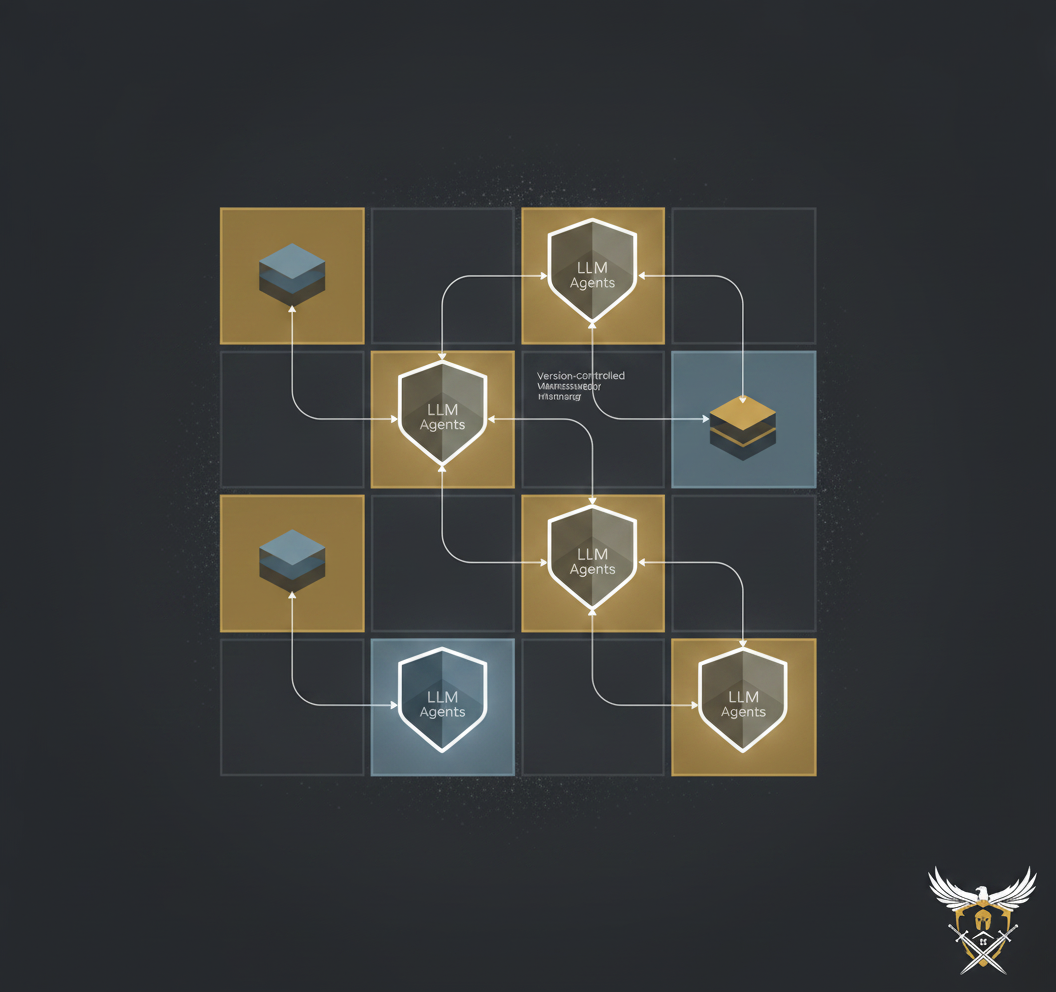
To build resilient enterprise agentic systems, principal architects must abandon monolithic context loops in favor of strict, deterministic state isolation. This requires three non-negotiable architectural layers:
- Immutable Task Snapshots: Every intermediate decision, tool call, and scratchpad delta must be committed to an append-only, versioned workspace ledger.
- Deterministic Task Ordering: Replace dynamic, unconstrained re-planning with constrained directed acyclic graphs (DAGs) that enforce pre-condition validations before workspace state transitions occur.
- Rollback and Branching Capabilities: When an agent encounters an anomaly or tool execution failure, the system must trigger an automatic rollback to the last verified clean workspace state rather than attempting ad-hoc prompt repair.
Without staged workspace protocols, multi-turn agent evaluation frameworks provide a false sense of security. They test for isolated reasoning capabilities in static environments, entirely missing the compounding entropy that destroys real-world enterprise deployments.
Upgrade Your Agent Evaluation Framework Today
Building dependable autonomous infrastructure requires shifting from hopeful prompting to rigorous, state-isolated systems engineering. You cannot afford silent execution failures in production environments where deterministic reliability is mandatory.
Audit your multi-turn agent architecture, enforce strict workspace boundaries, and implement deterministic state management before your next production rollout.
👉 See what's inside: https://kema-6y3wulmrr-knight-byrd.vercel.app/go/self-improving-agent-fragility/blog
KnightByrd Tech researches fast-moving digital trends and publishes practical, tested products and guides. About the publisher →